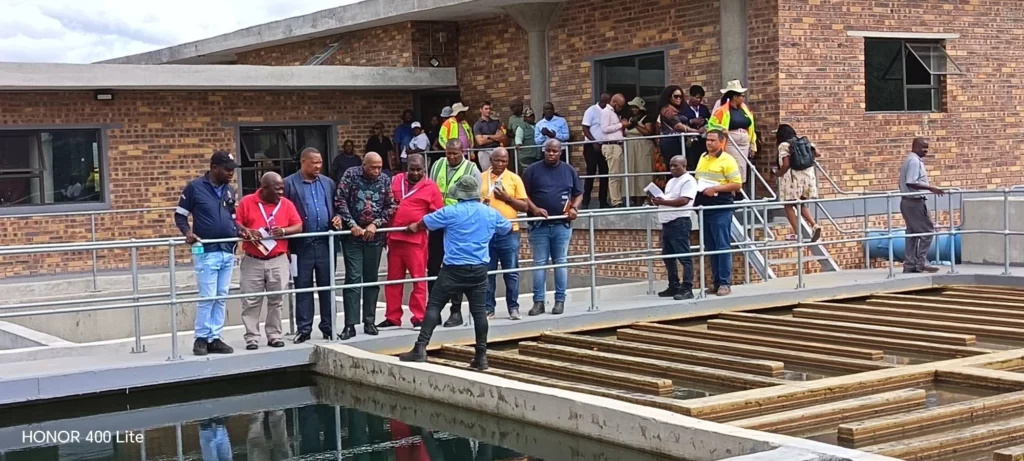
The Portfolio Committee on Cooperative Governance, Human Settlements, and Traditional Affairs (CoGHSTA) conducted an oversight visit to the Eerstehoek and Ekulindeni bulk water supply schemes on March 25. The visit forms a critical part of the Taking Legislature to the People (TLP) programme.
Committee Chairperson Daniel Nkosi, accompanied by fellow committee members, inspected the progress of the multi-million rand project aimed at stabilizing water provision within the Chief Albert Luthuli Local Municipality (CALM).
The project, which began in 2010, carries a total budget of more than R483 million . Spanning across Nhlazatshe, Elukwatini, Avontuur, Mooiplaas, Malahleka, and Buhleni, the infrastructure upgrade is divided into four distinct phases. Key contractors currently involved include Umthombo Engineering Phase 3 and A1 Glass & NKP Consultants Phase 4.
Beyond infrastructure, the project has served as a vital source of local employment, with 215 residents hired since its commencement.
The Chairperson emphasized that while infrastructure is essential, the priority remains “quality assurance” in the actual distribution of water to the 247,664 residents of the municipality. During the visit, Nkosi recommended that the facility be renamed to something more significant and “dignified” that resonates with the heritage of the local community.
MEC for CoGHSTA, Speed Mashilo, was present and committed to intervening “with speed” to resolve ongoing bottlenecks that hinder consistent water distribution across the Gert Sibande District.
While the Committee expressed satisfaction with the overall presentation, they were firm on accountability. The municipality has been directed to submit a formal report detailing how it will address specific issues raised during the inspection.
“The issues raised must be addressed speedily to ensure the people of CALM receive the services they deserve,” Nkosi he said.
After the inspection the Portfolio Committee on Community Safety, Security and Liaison held an oversight meeting at Elukwatini Community Hall to assess whether the community is receiving adequate services from SAPS and to listen to concerns raised by residents for further response.
The engagement provided a platform for community members to voice their challenges and highlight service delivery gaps. It should be noted that a post-TLP follow-up will take place after 18 months, during which the legislature will revisit the municipality to evaluate whether the issues raised have been addressed. This process is aimed at strengthening accountability and improving service delivery for the overall wellbeing of the community.